
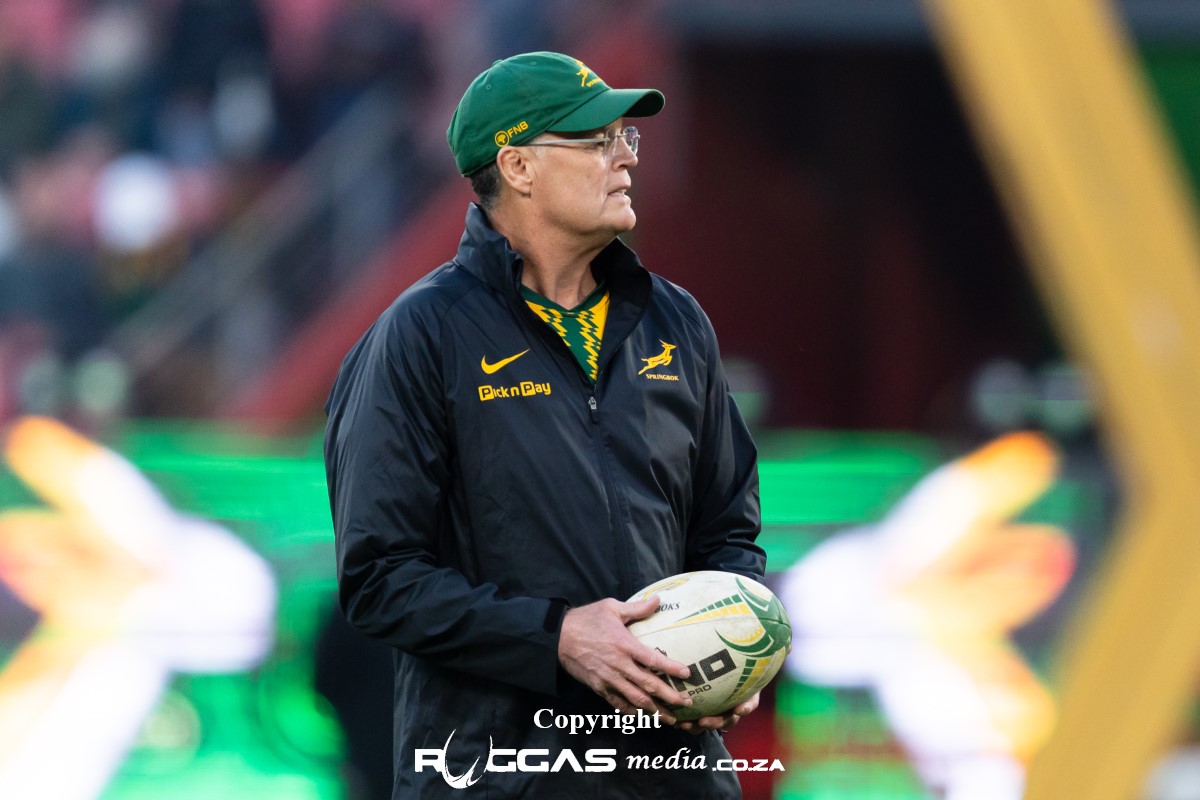
Coaches rarely enjoy longevity in South African rugby. The Springbok head coaching role is a notorious pressure cooker, historically defined by short cycles, intense scrutiny, and immediate fallout from a demanding public.
Yet, on Saturday, July 11, 2026, Rassie Erasmus entered entirely uncharted territory.
When he sent his characteristically experimental squad onto the pitch at Loftus Versfeld to face Scotland in Round 2 of the Nations Championship, Erasmus officially took charge of his 55th Test match as head coach. In doing so, he eclipsed Jake White’s nearly two-decade-old record of 54 Tests to become the most-capped mastermind in the 134-year history of Springbok rugby.
When factoring in his highly involved stint as Director of Rugby, this milestone marked the 94th Test match played under his direct guidance since 2018. It represents a monumental tenure that has already earned him the Order of Ikhamanga in Gold, South Africa’s highest civic honour for sporting excellence.
But the true genius of Erasmus’ landmark achievement is not just the length of his stay. It is how he has utilised that unparalleled longevity to engineer the most complete, ruthless tactical evolution in the history of the modern game.
The Architecture of Survival: 2018–2019. To appreciate the heights the current team has reached, one must remember where they began. When Erasmus first assumed control in 2018, the Springboks were adrift at sixth in the world rankings. They were a team stripped of identity, reeling from record defeats to the All Blacks and Italy.
Erasmus’ first tenure was defined by structural triage. Working with a deeply scarred player pool, he stripped the playbook down to core South African fundamentals:
* A brutal, immovable set-piece
* An aggressive, contestable kicking game
* A relentless focus on physical dominance
It was during this period that he introduced the "Bomb Squad", a heavily stacked 6-2 or 7-1 bench split designed to maintain an unyielding physical onslaught for the full 80 minutes. While a 65.4% win rate and an average of 2.88 tries per game reflected a conservative blueprint, it laid the rigid structural architecture required to lift the 2019 Rugby World Cup in Yokohama.
The Fortress of Containment: 2020–2023. Great coaches often fall into the trap of trying to replicate their finest hour. Erasmus bypassed this entirely. Following global glory, he stepped back into the Director of Rugby role, handing the day-to-day whistle to his trusted defensive lieutenant, Jacques Nienaber.
This allowed the Springbok coaching framework to specialise. While Erasmus managed overarching alignment and squad depth from the coaches' box, Nienaber clad the team’s physical foundation in impenetrable armour.
The metrics from this era remain legendary. The Springboks perfected a hyper-aggressive, suffocating rush defence that cut opponents to ribbons before they could reach the gainline.
* Points Conceded: Plummeted to 17.79 per match.
* Tries Conceded: Dropped to a miserly 1.59 per match.
The strategy yielded a second consecutive Webb Ellis Cup in 2023, but the attack remained capped at a modest 28.4 points per game. It was a system built on pure containment. As global opponents slowly began to decode the angles of the rush, the model was rapidly approaching its tactical ceiling.
"Rassie 2.0": Tears Up the Playbook. The defining hallmark of "Rassie 2.0" is an institutional willingness to tear down his own masterpiece in pursuit of perfection. Returning to the head-coaching hot seat after the 2023 triumph, Erasmus refused to defend his title. Instead, he chose to evolve it, immediately recruiting attacking guru Tony Brown to completely overhaul the Springboks' offensive mechanics.
The statistical transformation of this current era is staggering:
* 86.2% Win Rate: Practically unprecedented in today’s highly saturated, ultra-competitive Test landscape, representing a massive 13.5% leap above the Springboks' historical winning average (62.5%).
* 5.21 Tries Per Game: By implementing extreme attacking width, flat-to-the-line playmaking, and lightning transition speeds, South Africa’s try-scoring capability has exploded.
* 38.2 Points Per Match: A scoring rate historically reserved for mismatches, yet achieved consistently against the world's elite.
Crucially, Erasmus has defied the traditional sporting law of compromise. Usually, a team must trade defensive security for offensive flair. Under this modern system, however, the Boks’ points conceded have actually dropped to a historic low of 17.41 per game.
They haven't abandoned their legendary physical shield; they have simply learned to use it to create chaos, turning turnovers into instant, lethal transition tries.
A Legacy Beyond the Pitch. Ultimately, Erasmus’ legacy cannot be fully encapsulated by historic scorelines, tactical graphics, or his record-breaking 55 Tests. As SA Rugby President Mark Alexander noted, his greatest achievement remains the profound social cohesion he has generated across South Africa.
By actively reframing the country's diverse demographic makeup from a complex societal puzzle into the squad’s ultimate physical and mental asset, Erasmus has turned Springbok Test matches into a genuine, unifying celebration of national identity.
On the pitch, he inherited a broken, sixth-ranked team and sculpted it into a dual-threat tactical monster. Off the pitch, he has galvanised a nation. Innovative, uncompromising, and now officially the most-capped head coach in his country's history, Rassie Erasmus stands entirely alone as the greatest mastermind to ever lead the Springboks.
With South Africa remaining unbeaten in the Southern Series leg of the Nations Championship, few would dare bet against Erasmus’ juggernaut lifting the ultimate prize come November's Finals Weekend at Allianz Stadium.