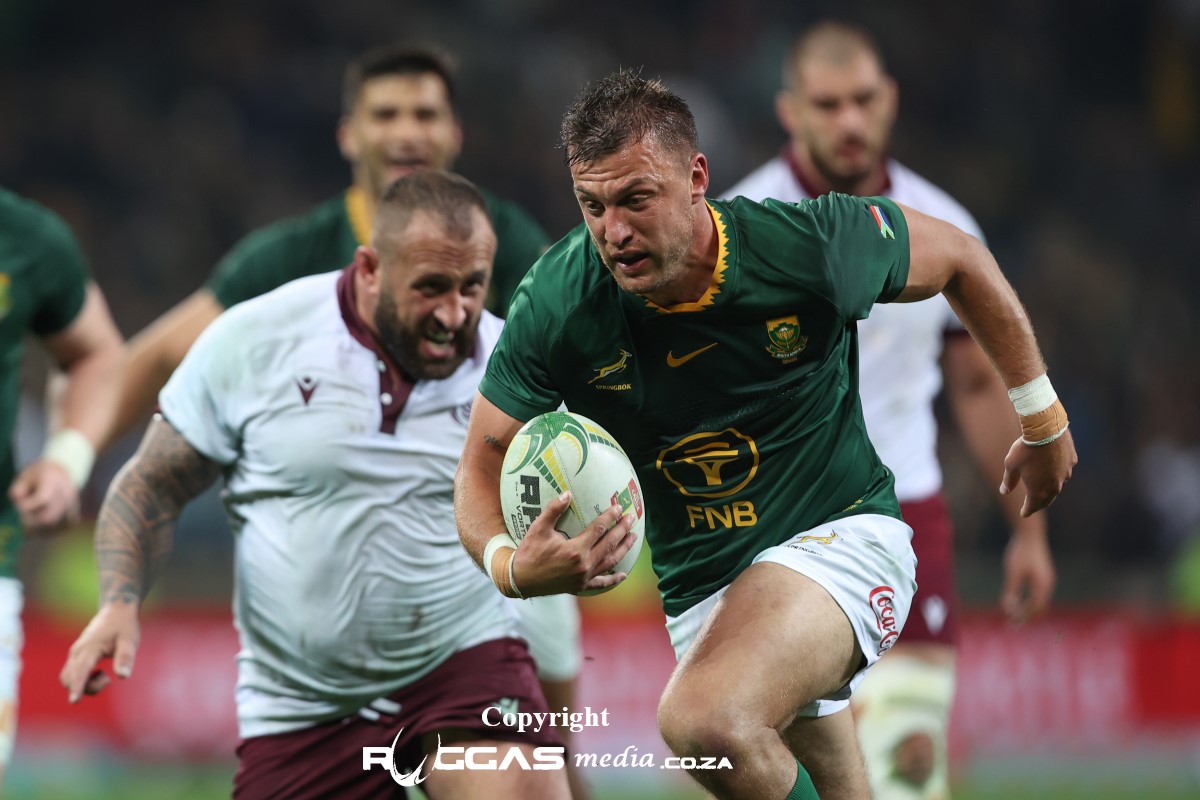
When the Springboks suffered a bruising 33-16 defeat to the All Blacks at Ellis Park, the collective panic of a rugby-mad nation could be heard from Johannesburg to Cape Town. The immediate solution from the coaching box? Break glass in case of emergency. Pull the lever. Bring back the Iceman.
By recalling Handré Pollard to the starting flyhalf berth for the subsequent Cape Town Test, Rassie Erasmus did what any pragmatic tactician would do: he traded experimental flair for cold, hard institutional knowledge.
Yet, as the Springboks navigate a transitional World Cup cycle, a familiar debate has resurfaced among pundits and fans alike. Is Pollard the perennial saviour of South African rugby? Or is leaning on the 32-year-old veteran holding back the evolution of the world champions?
The truth, as always with this Springbok team, lies somewhere in the pragmatic middle.
To call Pollard a "saviour" implies a team in desperate, chaotic ruin, which this Springbok outfit certainly is not, or are they?. However, to call him the ultimate big-game insurance policy is an undeniable fact.
Pollard’s legendary status is built on concrete, high-pressure evidence. He was the tactical heartbeat of the 2019 and 2023 Rugby World Cup triumphs. When the margins were razor-thin in Paris, it was Pollard who calmly slotted all 12 points in the 2023 final against New Zealand. When the Springboks' attack loses its shape, or when younger options falter from the tee, Pollard is the stabilising anchor who locks down territory, commands the defensive line, and punishes opposition indiscretions with monotonous accuracy.
Erasmus’s decision to start him in Cape Town after the Ellis Park stumble proved that when the pressure cooker reaches maximum capacity, there is still no substitute for Test-match pedigree.
While fans often debate selection as a purely tactical philosophy, Erasmus revealed that a string of untimely injuries heavily forced his hand ahead of the second Test in the Rugby’s Greatest Rivalry series. The loss of a certain utility superstar fundamentally changed the backline equation.
“We had a different team in mind. We hoped we could win the first Test match, and we wanted to try some things,” the coach said. “We hoped Canan Moodie would be fit. I would have loved to play Cheslin again. Then he got injured, and Grant Williams got injured as well. So there are a couple of changes that we wouldn’t have made, and others that we wanted to make, but because of us not getting winning momentum, it’s tough to make more changes.”
In Cheslin Kolbe’s absence, Pollard’s elite kicking boot carries immense tactical value, especially with adverse weather looming over the Western Cape.
“It’s Cape Town, and it’s probably going to be wet," Erasmus noted. "I think we played stupid [last week], and some of the messages came from me, on the pitch, you know, ‘two points is three points is two less than five’… With Cheslin out, and Cheslin kicks really well… We’re only flying down on Wednesday, and as I see the weather conditions, there is a chance for rain.”
Under stormy skies, the Bok boss opted for the ultimate big-game security blanket. “Handré has always been the guy that does it for us. He grew up in Cape Town; it’s his hometown, the same as Manie.”
The counterargument to the "Pollard-as-saviour" narrative is the Springboks' public desire to evolve. Tony Brown’s arrival as attack coach was a clear declaration of intent: South Africa wants to play with more expansion, speed, and ball-in-hand fluidity.
Younger playmakers like Sacha Feinberg-Mngomezulu offer a glittering, unpredictable offensive threat that keeps modern defences guessing. Manie Libbok possesses a running and passing game that perfectly unlocks Brown’s expansive shapes.
While Libbok missed out on the starting jersey this week, Erasmus was quick to reassure that the flyhalf rotation remains active. “I feel bad for Manie, but we know Manie is still going to play in the next two matches after this one. We think Handré is a good fit (this week).”
By contrast, Pollard represents structured clarity. He plays flat, absorbs heavy contact, kicks meticulously for territory, and suffocates teams through scoreboard pressure. It might not always ignite social media highlight reels, but it wins trophies.
Erasmus himself has previously cautioned media and fans, stating flatly that "Pollard is not Superman." It was a reminder that the Springboks' success has never been built on a single messiah.
South Africa wins because of a brutal forward pack, a revolutionary "Bomb Squad" bench strategy, and a defensive system that breaks opposition spirits. Pollard is not rescuing a broken team; he is simply the master technician who knows exactly which buttons to push within a highly functional system.