When the Springboks ran out to face the All Blacks in Soweto, rugby romantics and administrators alike were quick to champion a beautiful narrative. The starting XV made history by featuring 15 players from 15 entirely different high schools. From the gritty fields of HTS Louis Botha (Ox Nché) and HTS Drostdy (Wilco Louw) to the traditional corridors of Grey High and Bishops, it was presented as definitive proof of a democratic truth: South African rugby talent is nurtured everywhere, and the Springbok dream remains alive for any boy with enough grit and hard work.
Rugby administrators, scouts, and agents have been vocal proponents of this comforting gospel, using these diverse backgrounds to spread a message of boundless grassroots hope.
It is a beautiful story. It is also an outdated illusion that completely ignores how the elite game actually works today.
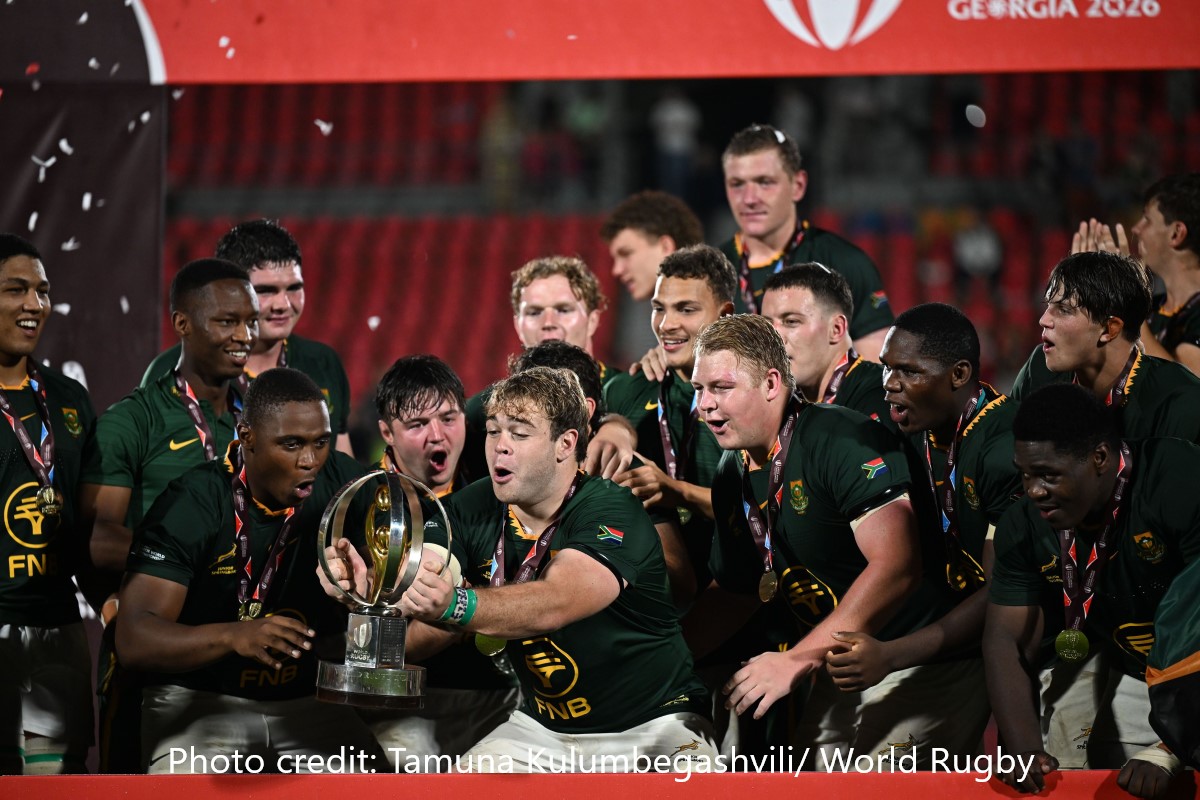
If you want a cold, sobering injection of modern reality, you only need to look at the Junior Springboks squad that successfully defended their World Rugby U20 Championship title in July. There, the romantic narrative is stripped entirely of its truth, exposing an ecosystem that has become ruthlessly centralised, hyper-optimised, and closed to outsiders.
While the senior Springboks in Soweto reflected a beautifully scattered map, the Junior Boks final against France reflected an industrial monopoly.
Out of the starting line-up, nearly 70% of the players were manufactured by just four elite institutions: Grey College, Paul Roos Gymnasium, Jeppe High School for Boys, and Afrikaanse Hoër Seunskool. The remaining positions were filled by boys from a tiny handful of other traditional rugby powerhouses like KES and Paarl Gimnasium.
There were no "undiscovered gems" from small-town schools. There were no late-blooming heroes from non-traditional rugby backgrounds. The Junior Bok squad is the true, unfiltered blueprint of modern South African rugby development: an airtight pipeline where elite talent is strictly manufactured in a few specific locations.
The core flaw in this “fairytale” narrative is a fundamental failure of timeline logic. The senior Springboks who played in Soweto represent the final generation of school leavers from 15 years ago.
In 2011, the modern, multi-million-rand corporate schoolboy scouting programme did not exist. No dedicated digital streaming apps were tracking the biological metrics of 14-year-olds. Talent identification was reactive, largely compressed into a single week in July at the U18 Craven Week. If a boy at a smaller school had a late growth spurt or went unseen, he could still finish school, play club or university rugby, and work his way to the top through sheer merit and determination. The playing field was relatively level because the system hadn't yet been weaponised.
Today, the landscape is light-years ahead, and that organic pathway is dead. Through SA Rugby’s Elite Player Development (EPD) programmes and aggressive high school talent-hoarding, scouting is now predictive. If a 13-year-old boy shows a shred of elite genetic potential, he is bought and absorbed by a rugby factory before he even hits puberty.
This is not merely a matter of unfair gatekeeping; it is a reality of high-performance sports science.
The top-tier schools are no longer just educational centres; they operate as professional academies. They feature full-time biokineticists, costly individualised periodised strength and conditioning tracking, scientifically monitored nutritional regimens, and specialized coaches executing elite, franchise-level templates.
When the Junior Springboks play five test matches in less than three weeks at a World Cup, the physical demands are staggering. A boy from a smaller school, regardless of how naturally gifted or brave he is, most probably will not survive that environment if he has not spent his crucial growth years building the skeletal and muscular density that only an elite school's conditioning program provides. They are simply too far behind the high-performance curve by age 18 to ever catch up.
Optimists will argue that a truly brilliant, exceptional talent will always break through the cracks. While every decade produces a rare genetic freak who forces the system to notice them, relying on statistical anomalies to validate a development system is a delusion. Furthermore, it completely ignores the psychological and tactical damage done to a player who remains isolated at a smaller school.
In a non-traditional rugby school, the star player is forced to carry the entire team's dreams on his back. This creates a "hero rugby" dynamic. The star is given total freedom to wander out of position, break structures, and take low-percentage individual risks because his raw brilliance is the team's only hope of winning. Because the team is entirely dependent on him, coaches rarely discipline him for poor defensive spacing or bad habits.
When that superstar steps into a provincial U20 franchise academy, the culture shock is fatal. For the first time, everyone around him is just as fast, strong, and talented. When a franchise coach demands that he hold depth, execute a specific defensive drift, or hit a particular ruck option, the hero-rugby player's instinct is to break rank and try to win the game alone.
To a professional coach, this isn't brilliance; it is an uncoachable liability.
The worst part of this fairy tale is not just that it is wrong; it is financially predatory. By feeding parents the myth that any "unlucky" kid simply needs a little extra push to make it from a smaller school, a toxic secondary market has exploded.
Desperate to keep the Springbok dream alive for their sons, well-meaning parents are spending hundreds of thousands of rands out of their own pockets on private, cash-hungry rugby academies. South Africa now features a massive concentration of these private rugby academies, all thriving on the hope of desperate families.
This is where rugby administrators, scouts, and player agents strengthen their arguments. They leverage the grassroots myth to convince parents that a private academy is the missing stepping stone. When the inevitable provincial rejection happens, these same agents and scouts shift their goalposts, using their influence to convince families to send their boys to second- and third-rate clubs overseas or locally under the guise of "gaining experience."
In reality, they are selling snake oil. They are happy to drain the bank accounts of hopeful families while knowing full well that the elite junior franchise slots are already locked down by the mega-school factory system. The parents pay the massive bills, the academies and agents cash the cheques, and the player remains completely outside the actual loop of modern identification. It is the monetisation of false hope.
Modern United Rugby Championship (URC) franchises operate under intense corporate pressure to win trophies. When players arrive at the junior ranks, franchise coaches have absolutely no time for remedial development. They are coaching to win, period.
Franchises expect "plug-and-play" athletes. They expect teenagers who already possess five years of elite gym data, structural tactical literacy, and the psychological resilience built from playing in front of 20,000 screaming fans at a televised Interschools derby. They do not have the time, patience, or budget to deprogram years of bad tactical habits from a small-school star or try to reconstruct a player from a private academy when Grey College or Paul Roos is turning out disciplined, system-ready athletes who transition into professional structures seamlessly.
Rugby administrators, scouts, and agents are selling a romantic, nostalgic brand of hope to grassroots South Africa, but they are conveniently looking at an old blueprint that has long since been discarded. The modern game does not wait for late bloomers, nor does it look for heroes on untelevised fields. The Soweto fairy tale is a marketing masterpiece, but for the thousands of boys outside the factory walls, the gate is already firmly shut.
Is it fair? No, but unfortunately, it is the Monster that rules the road to Springbok greatness. You would be far better off spending that money on post-school qualifications, allowing your "unfortunate" child the opportunity to develop naturally at a quality local club or university.